Avid reader of NeuralAYM or not, it is well known that the brain is capable of being the CPU of the body due to its elaborate neural pathways. Complex wiring of a multitude of thin, dwindling fibers all throughout the body are responsible for everything we say, do, and feel. If these fibers interconnect all of our nuts and bolts, than something must be passing through these fibers to ensure that all of our parts receive the correct information for a certain stimulus. Moreso, that “something” must have a mechanism to ensure that it is capable of being passed from neuron to neuron across the whole body, and simply does not fade away. The components and electrical properties of neurons do employ just the right mechanism, and it is known as signal propagation. While it has many steps, the ultimate end goal is to simply reach point B from point A. The beginning of this article is point A, and by point B, you will know exactly how information gets from point A to point B

Electricity and electrical properties are entirely responsible for the brain receiving, processing, and relaying information. Axons and dendrites(Scholarly Sunday 1!!) keep the electricity flowing from neuron to neuron, but not in one continuous jolt. It is a constant process of restarting the signal, from neuron to neuron
Want Brain Games for Discount?? Keep your mind stimulated for life!
Merrily Merrily Down The Stream
Keep It At Rest
Signals are obviously transmitted within the body, but remember, the body does everything for survival; a neuron won’t start sending signals for no reason. An important starting point which we must remember is that neurons have a stable membrane voltage, somewhere around -70 Millivolts. This means that the inside of the neuron is slightly more electrically negative than the outside environment. This is due to the presence of charged ions. The neuron has higher concentrations of Chloride, a negatively charged ion, than the outside environment, along with other proteins. That, along with lower concentrations of ions such as Sodium within the neuron combine to form a negative internal potential. The thing is, maintaining this resting potential is enough work as it comes with. In biology, you may have heard of a “concentration gradient.” Ions have the tendency to slowly diffuse in and out of the neuron, dependent on which area has lower concentration of that specific ion. In passive diffusion, with no external energy applied to the system, a substance which has a lower concentration in some area will tend to drift towards that area, due to random displacement and higher probabilities of flowing to that area. However, a constant ion flow would disrupt the resting electric potential, potentially causing misfires within the body. Hence, nature has provided us with the Sodium/Potassium Pump, a mechanism which keeps the vital ions Sodium and Potassium at a relatively constant ratio within the cell. Preventing these ions from freely flowing across their respective gradients also prevents a drastic change in the membrane potential, keeping neurons in their standard states.
As you read, ions are crucial to maintaining the electrical balance within neurons. Steady ion ratios between the intra and extracellular environments keep the electrical potential stable and a neuron at rest. By extension, it could be inferred that an active neuron would presumptively assume a very different electrical potential for the duration of its activity. Let’s see…
Lights, Camera, Action
That one paragraph alone was quite informative! But, it was only the lights- the camera and action have yet to reveal themselves. We know that neurons don’t randomly fire and cause twitches, unwanted emotional responses, etc. We also know that they are kept stable through a relatively constant ratio of extra/intracellular ionic flow. But, what happens when neurons do need to fire? Many neurons receive the signal from their counterparts, but what about the first neuron in the sequence…is it magic? Does it employ fantastic guesswork to pair up its electrical signaling right when we experience some stimulus? Well, no. Signal propagation begins with something called an action potential, and in fact, is technically a series of action potentials; but we don’t have to worry about the series yet, just the initiating point. Magic does not cause the first neuron to fire- external stimuli does. When the neuron senses some change in its environment–sensory, chemical, situational, depending on what specific function the neuron serves–the probability of a Sodium Voltage-Gated Ion Channel opening increases. As the name suggests, these Ion Channels keep opening with an increase in voltage. In a process known as depolarization, when the influx of sodium causes the electrical potential to rise to -55 mv, the floodgates open. Sodium channels open rapidly, causing the potential to reach a whopping +30 mv. The Sodium channels slowly close and inactivate after this threshold, and Potassium Voltage Gated Channels open. In a process now known as hyperpolarization, the high concentration of Potassium flows outside of the neuron and causes the electrical potential to go down all the way to -90 mv, decreasing the probability of a subsequent action potential in that neuron, at that time, and allowing for a “reset” period.
How Long Do You Last?
The body is a world of probabilities. Ion channels don’t recognize a specific voltage and spontaneously open. Voltage-Gated simply means that at a specific electrical balance, they are more likely to open. Hence, when there is a rapid influx of ions inside the cell, they have all the likelihood to travel back out based on simply diffusing out…except, they can’t. Nature to the rescue once again. To prevent ions from simply flowing out the cell and ensuring that they can make their way to the end of the axon, to be propagated onto another neuron, the axon has structures called “myelin sheath.” Myelin sheath are coverings which act as an insulating layer around axons, to prevent the flow of ions outside of the cell. “But how do ions get in??” Well, there are tiny gaps in between each segment of myelin known as “Nodes of Ranvier.” When the first influx of Sodium occurs at the -55 mv threshold in a certain point of the neuron, a large majority of that Sodium travels down the axon and only a small portion make it out. When the initial influx reaches another node and causes the electrical potential to rise to -55 mv at THAT point along the axon, the ions flow in, and they reach the NEXT node even faster and MORE ions flow in and they make it all the way to the target…wait, slow your roll, they make it all the way to the end of the neuron. Don’t let your own brain get ahead of itself. Myelin sheath is coated along the axon to ensure that the ionic flow can make it to the end of the neuron
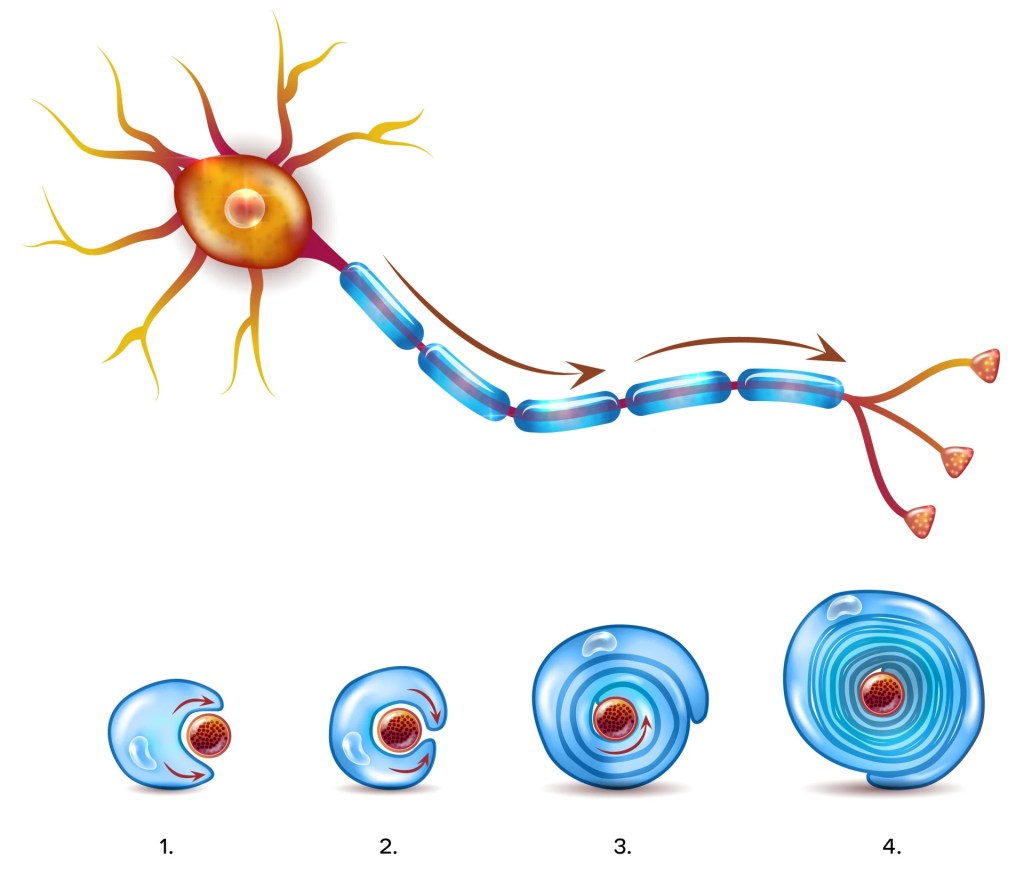
The Myelin Sheath(pictured in blue) prevent ionic flow out of the axon to ensure that the electrical disruption flows all the way to the end of the neuron; additionally, they have gaps between them (minutely illustrated) so that ions can actually flow inside as well
From Me To You
The End, Or The Beginning?
Don’t worry, we weren’t going to make it through this whole article without talking about possibly the most exciting component of the nervous system- neurotransmitters. But be patient, we’ll get there. At this point, our ions have reached a point in the neuron known as the Presynaptic Terminal. For reference, the synapse is the junction between two neurons(Previous Scholarly Sundays!!). When all of the ions reach the Presynaptic Terminal, the sudden presence of electrical charge lets a different ion through- Calcium. You may have heard that Calcium is a vital element of the nervous system, but this answers the question as to why. A family of proteins known as synaptotagmin(hint: synapse) contain a transmembrane domain. The reason why Calcium is so crucial is because it has the ability to bind to synaptotagmin, and acts as a catalyst for vesicle release. Speaking in probabilities again, If you have read NeuralAYM articles in the past, recall that Neurotransmitters are stored in vesicles. When Calcium binds Synaptotagmin, vesicle fusion between Neurotransmitter Vesicle Proteins and Presynaptic Membrane Proteins lead to vesicle fusion to the membrane. Neurotransmitters are released from their vesicle and bind to either excitatory or inhibitory receptors- of course, it is self explanatory which of these receptors causes the signal to propagate further down the body. Depending on the neurotransmitter released and which neuronal pathway releases it, we experience different responses- e.g. when we complete a difficult task, dopamine will be the neurotransmitter released when our body signals to us that completion has occurred
Excited To Transmit
Let’s assume that the action potential was sufficient and the Neurotransmitter which was released was excitatory and it bound to an excitatory receptor(for the sake of the article)…a perfect scenario. What happens in this awkward state where the signal is about to flow into the postsynaptic neuron, but hasn’t quite yet done so? Well, the neurotransmitter does not last on the receptor forever, enzymes and proteins will either break it down or it will flow back into its hidey-hole. If it lasted forever, signals in postsynaptic neurons would just keep firing and firing. However, that momentary binding of the Neurotransmitter(again, assuming excitatory) ignites an Excitatory Postsynaptic Potential, or an EPSP. From the way we have been using Potential in the article so far, you probably assumed that this has something to do with a disruption in the resting electrical balance, likely in the positive direction. It is! Signal propagation is one big loop of one identical process, which functions via thousands or millions of individual components. The binding of NT to receptor causes a change in the shape of the receptor protein(a conformational change). Positive ion channels either directly associated with or at least adjacent to the receptor will open, causing that depolarization. If the soma, the cell body(Scholarly Sunday 1!!!) determines that the sum of various depolarizations are great enough, it will generate another action potential at the postsynaptic neuron’s axon hillock, which can travel down the axon and make its way across the neural pathway, delivering an intended effect.
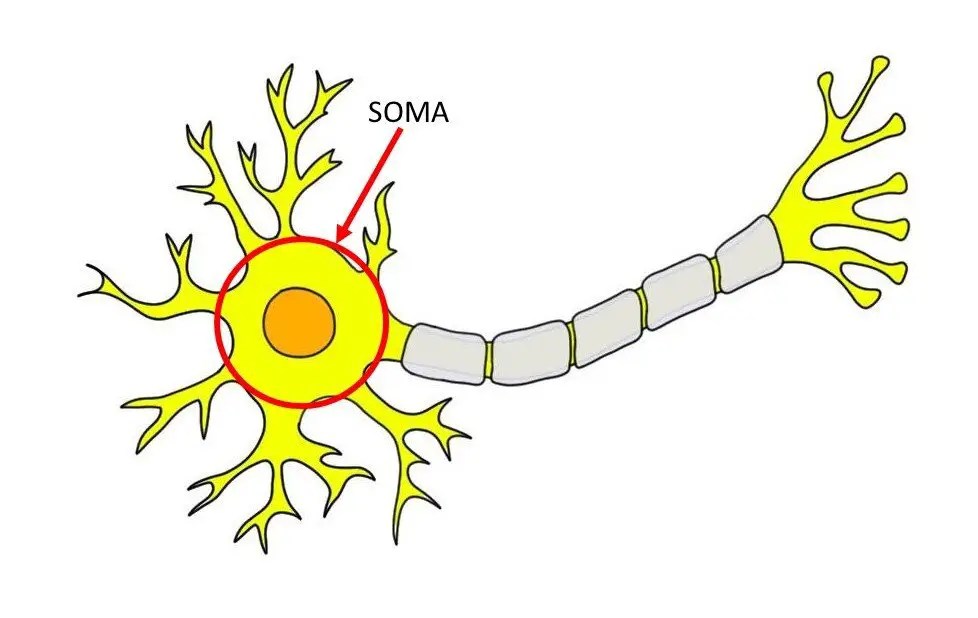
Just because one neurotransmitter stimulates an excitatory response, doesn’t mean it will be sent all the way down. The soma will integrate various incoming stimuli from neurotransmitters and determine if the incoming input is substantial enough to deliver a forthcoming action potential
A History Of Excitement
Bernard Went Crazy
Normally, the History is at the beginning. However, it is located at the end of this article due to two reasons. 1. Revealing the history behind synaptic interaction would have oversimplified the entire matter, and 2. The experiment is quite a scientific marvel and requires a solid foundation to achieve a deep appreciation for it. It all starts with The Bernard and the Frog…no, he did not smooch the frog. In the neuromuscular junction, Bernard Katz stimulated a presynaptic neuron, and he discovered small blips on an electrode, indicating a change in electrical potential. However, the blips were not present when the electrode were placed on the presynaptic side, indicating that the stimulus passed along from the presynaptic neuron onto a postsynaptic receptor of some sort. What was particularly interesting is that when there was a limited amount of Calcium in the manipulated extracellular fluid, the postsynaptic action potential was not particularly powerful, indicating the importance of Calcium for continuous signal propagation. The experiment was simple- stimulate an area, observe the electrical balance in another- yet the knowledge was groundbreaking
Wrapping It Up
Signal propagation, while seemingly complex, is a relatively simple yet marvelous process. It is another example of nature’s fine perfections, its minute attention to detail, its precise mechanisms for survival. It’s beautiful
Follow the Instagram= https://www.instagram.com/neuralaym/
Subscribe to the Page= neuralaym.com




 NeuralAYM
Leave a comment