The exam worth 75% of your grade looms large over your hnead. The impending doom of getting home 30 minutes late when your mother said 10:00 PM sharp. The Homecoming game in 2 days against the best defense in the entire state. Your first driving test with the instructor who historically fails everybody. No…these are not killing your brain. Actually, these natural responses may prove vital in heightening your ability to perform, rendering you alert and focused during the task, drowning out potential distractions. However, what about a state of chronic stress? The constant thought of being let gone by your boss leering like a rain cloud in the back of your mind. The fact that your relationship is hanging on by a thread and you’ve just forgotten the date of your anniversary and are afraid to ask. The class you signed up for in optimism, now presenting itself as the most difficult scientific entity of the past few centuries. Are these responses vital? Perhaps. But, are they healthy? That’s up to us to study

In the modern world, Chronic Stress is sadly treated as collateral damage that naturally accompanies a hustler’s lifestyle, a go-getter mentality, or a co-requisite of ambition. While some levels of daily stress in intervals are normal and can actually keep us alert and sharp, Chronic Stress that looms over your mind in completely irrelevant situations can do permanent, sometimes irreversible damage before any signs and symptoms are noticed. Hence, it is crucial to educate ourselves on the potential damage so we actively train our minds to prevent ourselves from going down an endless hill
© ChatGPT, 2026
The Wonders Of Worry
Blending Colors
Stress is quite a multi-faceted topic, nearly impossible to examine without understanding how its components blend together. Playing to our strengths, we’ll first zero in on the primary neural centers involved in the stress response and their sequence-based involvement, and transition into the molecular components. So, of course, the first step involves recognition. When the brain processes sensory inputs, the input follows two different ‘roads.’ The first road involves Thalamic input directly to the Amygdala, known as the ‘Low Road,’ which operates on a ~12 ms timescale. The second involves Thalamic input projected to the Cortex, which then reaches the Amygdala, known as the ‘High Road,’ which operates on a ~30-40 ms timescale. The difference between the two paths is the amount of context they carry. Both have advantages in terms of the speed at which the Low Road transmits information, and the amount of information the High Road carries. Now, as this input makes its way to the Amygdala, specifically the Basolateral Amygdala, we have to call upon one more friend (who we’re no stranger to)…the Hippocampus! As cortical (High Road) input makes its way to the Amygdala, it’s not as if this input is totally isolated. A similar fear-based experience has likely occurred before. Stored hippocampal with certain similarities can actually fire if the incoming sensory input somewhat matches the context under which the previous memory was formed. If the context matches the current event, it increases the probability that the BLA will fire downstream. But, what does it fire to?
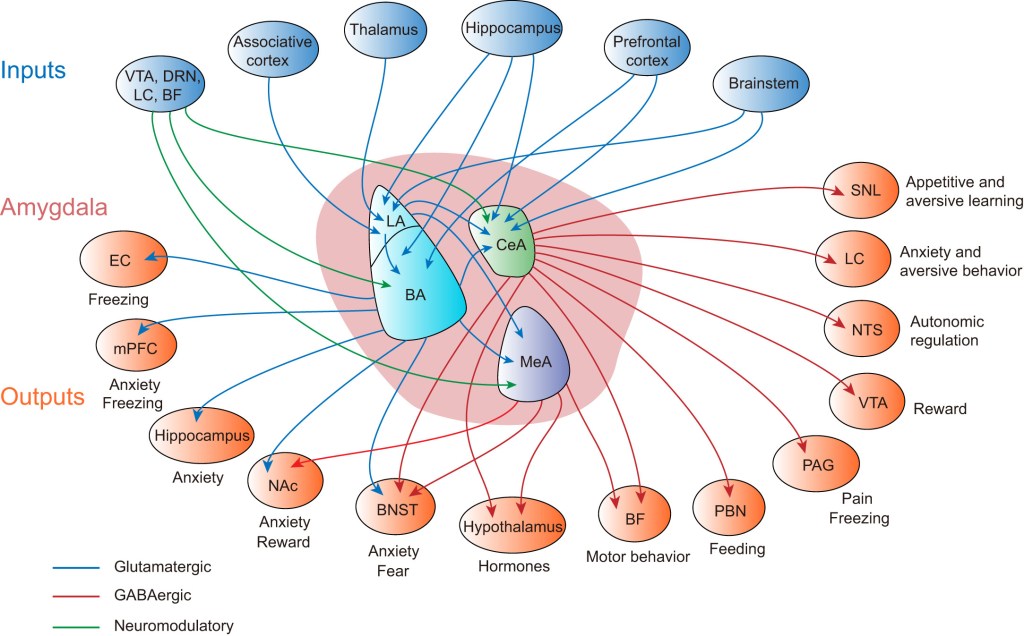
Spoiler Alert: This is a comprehensive outline of the general Amygdala Network, in terms of relevant areas it receives input from, and the functional outputs that it produces. Notice the type of outputs that are produced, mostly relevant in emotional context
© ScienceDirect Zhang et al 2021
Where’s The Switch
While we’ve outlined how stressful experiences reach our cognitive centers from a processing standpoint, it doesn’t end our discussion of the neural cascade that results in that eerily familiar chilling of the skin, raising of the hair, and speeding of the heart. See, the Basolateral Amygdala may be responsible for determining what actually gets filtered to be a ‘threat,’ but it’s the ‘Switch’ alluded to in the title of this section that allows us to consciously respond to the stimulus as a threat. This Switch is known as the Central Amygdala, which directly receives projections from the BLA. The Central Amygdala is the primary effector responsible for triggering the widespread, classical ‘fight-or-flight’ response. It may strike you as a potential surprise, but the Central Amygdala actually doesn’t have a classical role in the processing of threat from a cognitive sense. The Central Amygdala’s principal duty is as an intermediary hub in order to regulate the function of the Autonomic Nervous System, projecting to a structure which has been harped down the throats of neuroscientists, endocrinologists, and biologists alike. A structure responsible for a heavy portion of many physiological responses…you likely have already predicted correctly…the Hypothalamus (along with some other, potentially new friends).
Fight or Flight
The Hypothalamus is introduced relatively early in Neuroscientific discussions due to its versatile role in, well, many hormonally regulated processes, sleep and sexual drive not being the least prominent. However, our focus shifts to stress. At this point in our journey, a stressful stimulus has been recognized and input has reached the Central Amygdala, the output region. Remember, we’re still dealing with Acute Stress, NOT Chronic Stress. Within the Central Amygdala are 2 subdivisions, the Lateral (CeL) and Medial (CeM). If an aversive stimulus reaches the CeA, the CeL has populations of neurons known as CRF and SOM∂, and SOM∂ inhibits the CeM. However, upon arrival, the stimulus can activate CRF, which inhibits SOM∂, and in a ‘double negative,’ reverses the inhibition of the CeM, and activates the CeA as a whole. Now, we must transition primarily to the CeM, and the famous pathway that everyone associates stress with. The HPA Axis. The Centromedial Amygdala, now ready to fire, has many output points, but we’re specifically focused on the Hypothalamus (no shocker), which contains the Paraventricular Nucleus. The PVN releases Corticotropin Releasing Factor (CRF, colloquially), onto the Anterior Pituitary Gland. Hint hint, one of the first things we’re taught is about how the Hypothalamus often projects onto the Pituitary! The A.P releases Adrenocorticotropic Hormone onto the Adrenal Cortex, which releases Glucocorticoids…and these little guys form the basis of the entire next section
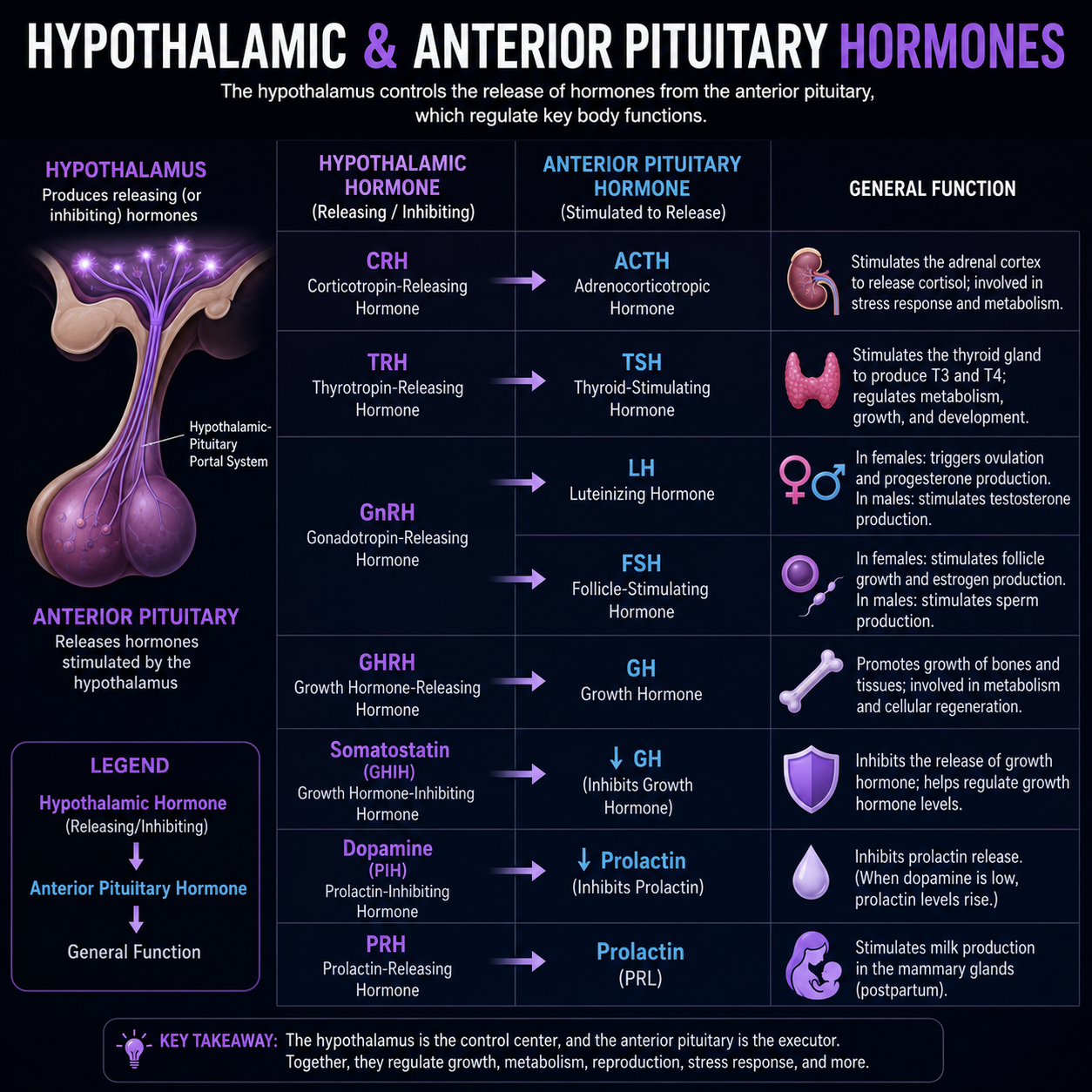
Although definitely not needed for this particular topic, this is a comprehensive list of the major Hypothalamic Hormones. Notice that the Hypothalamic Hormones aren’t independent agents; they’re all relying on some form of downstream signaling to relay the message, because the Hypothalamic Hormones can either Stimulate or Inhibit release of further Hormones. Not everything which is released automatically has an amplifying effect…in many cases, as we will assuredly see below, it’s actually quite the opposite.
© ChatGPT, 2026
Don’t Lose Sleep
Self-Servicing Traffic Light
Fittingly, in the second section of the article, we move to Chronic Stress. It was obviously crucial to understand what contributes to our stress response, specifically Glucocorticoid release, but we have to now stop tunneling our thinking towards Acute Stress alone. Glucocorticoids come into play a minimum of 15-30 minutes after the stressor. So, why are they significant? It’s because Glucocorticoids, quite literally, are power-hungry. Let’s first focus on how they regulate themselves, and then their systemic regulation, because these sub-sections are going to be doozies.
Interestingly, enough, while Glucocorticoids elevate during episodes of Stress, they themselves are actually responsible for initiating mechanisms which ‘calm’ the Stress Response post-stimulus. Of course, this does not occur right away; suppressing the fear response during an actual stressor is dangerous for…various reasons. However, when the Glucocorticoid concentration is elevated, it controls the Stress Response on short and long time scales. Pituitary Glucocorticoid Receptors which are occupied and hence activated are responsible for actually decreasing ACTH production, resulting in a ‘partial brake’ effect. Furthermore, the elevation of Glucocorticoids upregulates expression of FPKB51 (I know, they just make names up). FPKB51, however, does not serve some alien-like function; it actually does something quite practical. It alters the configuration of the binding pocket of the Glucocorticoid Receptor so that binding does not occur perfectly, and the stress response is somewhat controlled.
On a long-term scale, around hours or even days, Glucocorticoids function to return the Hippocampal-PVN Axis back to baseline. The Hippocampus does not normally excite the PVN. In quite the opposite fashion, it consistently inhibits it at a physiological state of rest. Through Genetic regulation, Glucocorticoids assist in the expression of factors which downregulate ACTH/CRF Synthesis and the overall sensitivity to the Stress Response, returning the brain to a state of rest. But, what happens if that rest never comes?
Chronically Offline
Just to be clear, I might have made it sound like Glucocorticoids weaken the Stress response. No, that’s not what they do. They regulate the stress response. Although that involves playing a role in the process of cooling the Stress Response, they also play a large role in elevating it. It is because of Glucocorticoids, in conjunction with Norepinephrine (Adrenaline), that stressful memories are so well remembered. It is because of Glucocorticoids that we have such a robust energy response to the stressor, and why we feel so drained after the experience. Glucocorticoids are responsible for increasing Receptor expression of Adrenaline-Responding Receptors, which is why our heart can feel as if it’s pounding out of the very chest cavity that houses it. You can start to see why keeping Glucocorticoid concentration elevated by remaining chronically stressed is so dangerous. But, the acute stress response isn’t actually the main reason why Chronic Stress is highlighted as so dangerous. The real ‘poison’ that we mentioned in the title comes from rather Chronic events rather than acute sensations of stress
Persistently elevated Glucocorticoid levels, a sign of Chronic or unresolved Stress, causes Cellular, Molecular, and Systemic damage that we may not even be aware of until the damage is frighteningly noticeable. While we won’t outline every single molecular pathway, there are some absolutely key consequences we must be aware of. Molecularly, the major consequence is the suppression of BDNF, a big name even in the non-neuroscientific community. BDNF is an all-around growth molecule, scientifically called a ‘Trophic Factor.’ The suppression of this molecule leads to a decreased ability to learn new things, create new neurons, form new neural connections, and maintain existing ones. Molecularly, you destroy the very framework of what made your brain so special…its ability to consistently rewire itself Cellularly, over a sufficient time period, elevated Glucocorticoid levels will eventually result in cell death in the Hippocampus; and neural death is not like other apoptosis, because neurons essentially do not regenerate. The circuit is tainted forever. And, Systemically, it doesn’t stop. Chronic Cortisol (the primary Glucocorticoid) elevation results in a lessened default Hippocampal inhibition of the HPA Axis, and it can feel like everything gets you angry. The Prefrontal Cortex also suffers from the same ailments as the Hippocampus. Its connections are withered and it undergoes atrophy; your cognition literally fades away. Your ability to control your own self erodes like a decaying banana. You lose your very essence, because your problems became them
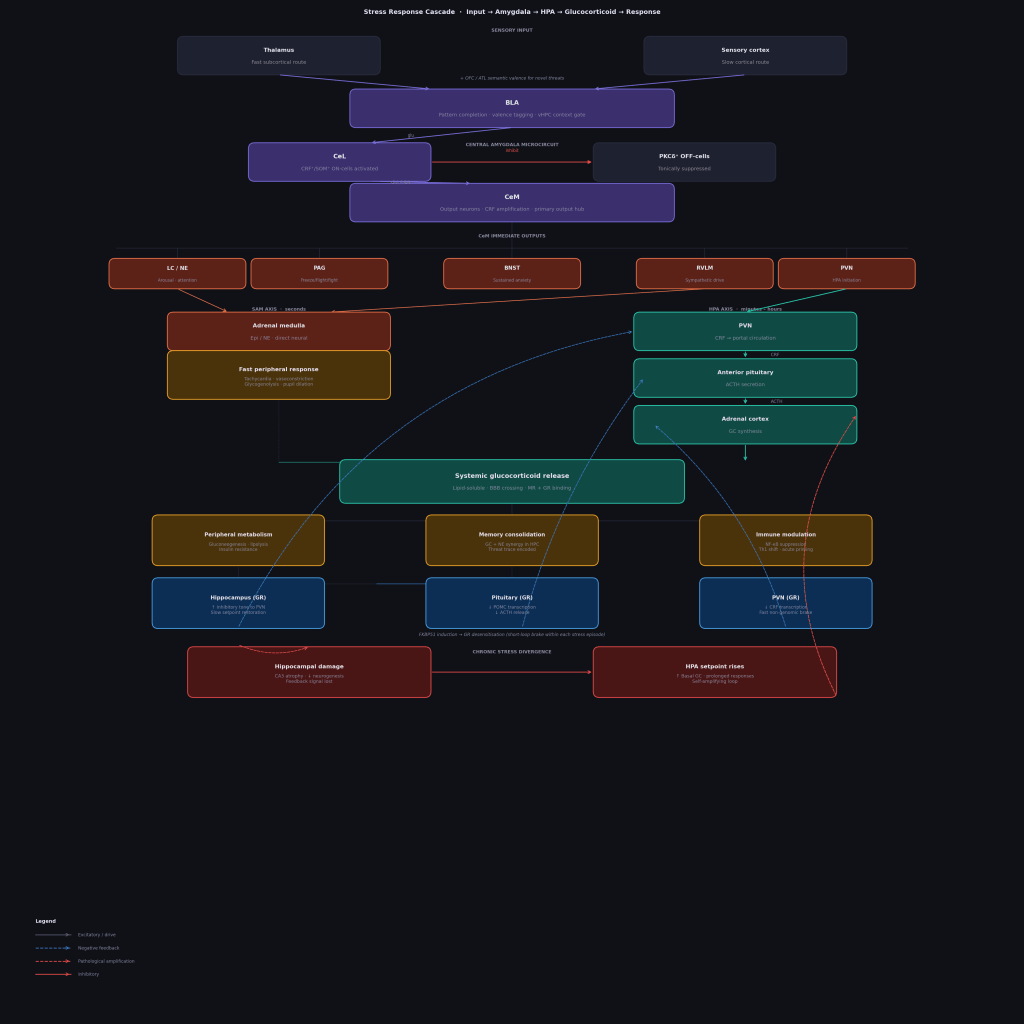
Intricate, right? Yes, this is a full diagram of everything we’ve talked about, from the moment the sensory input hits your brain, to the long-term damage that remaining in this agonizing state of worry and anxiety can do. Note that in the diagram, the different colored arrows represent different types of input/effect, denoted in the Key in the Bottom left I don’t blame you if you wish to Zoom in and refresh your memory on a specific point of the pathway; sequentially, it goes Input -> Effects, top to bottom. Just don’t forget we have one more piece of the puzzle to fit
© Claude AI, 2026
Past The Brain
While the true intricacies of the devastation that Chronic Stress can internally cause may be a genuine revelation, this last section will be more of a grave reminder of the physical effects of what such a poor mindset/cognitive lifestyle can lead to. First of all, your immunity declines in a manner directly correlated to the acceleration of a growingly inflamed domain. Glucocorticoids actively suppress immune genes…they don’t just neutralize them, they stop their entire production. The feeling of ‘sickness’ one may feel due to stress is not simply a placebo; it is quite likely that regular exposure to pathogens could result in adverse effects due to the increased vulnerability. Almost paradoxically, inflammation throughout the body increases. NF-KB, the transcription factor that regulates the production of various inflammatory cytokines, is actually reduced in the presence of Glucocorticoids. However, chronic exposure in the body leads to desensitization. NF-KB begins operating with minimal regulation, because its responsiveness to Glucocorticoids has dampened, leading to heavy inflammation. For my gym rats, muscle growth is directly impaired. To the general populace who may be under the impression that this doesn’t apply to them, muscle loss will directly ensue from Chronic Stress. The body, in a state of Chronic Stress, constantly mobilizes resources to provide energy to deal with the ‘threat.’ This is why weight loss and physical exhaustion is so common in truly stressed individuals, because their glycogen stores are literally constantly being used for energy. Even Physically, the effects of prolonged states of stress are devastating
Wrapping It Up

This isn’t to say that all forms of Stress are bad. I mean, the preliminary discussion outlined, in some manners, how stress is beneficial for our health and overall environmental processing. By heightening our senses and sending signaling cascades that enhance the encoding of the stressful experience, we are able to increase wariness in the future. It’s just that, we have to understand how and when to calm ourselves, so that when the real stress does hit, we aren’t left feeling overwhelmed….or worse, completely numb





Leave a comment