Over the years, the field of neuroscience and neurology in general has produced some interesting, trailblazing, and downright wholesome experimental results. Accidental findings, experiments executed to perfection, compilation of all of these tidbits to form one, big, seamless whole. However, one of these findings reigns more famous than the rest, one that seems to grow increasingly popular as time passes. The hippocampus is a structure that not just those interested in neuroscience, but seemingly everyone knows these days. It is the first structure taught to little kids when they learn about the electrical magic that is our brain, arguably the most distinct structure shape-wise, and stores all the happenings which occurred in our life. However, what if I told you that its functional discovery is likely the most interesting tale in the neurological world?

A boy riding along on his bicycle. How could such a mundane event fuel one of the greatest scientific discoveries of all time? In fact, what are we even talking about right now? I seem to have forgotten…
Lucky Accidents
Initial Markings
To understand how our story begins, we must visit the prequel, a prequel which occurred much earlier than the climax. Our tale focuses on the story of an individual named Henry Molaison, or, H.M. for short. H.M. was happily frolicking outside when he was hit by a bicycle, only at age 7. At age 10, he began to suffer from seizures, and by age 16, it was quite an issue. It was further diagnosed as true epilepsy(NIH). These surgeries persisted until age 27, H.M. had likely suffered for too long. According to NPR(2007), H.M. was actually a very intelligent boy, but finished high school quite late, highlighting the extent to which he suffered from these seizures. Later in life, he was unable to hold his job down, and as a result, was forced to have treatment performed on him. The neurosurgeon who operated on him removed his hippocampus, and although the epilepsy stopped, why did the doctor decide to remove his hippocampus? Normally, the hippocampus is associated with a completely different function, which we will get to…but first, the crucial question. Why was the hippocampus removed in this case?

Contextually, you can probably infer that the man below is H.M., and unfortunately, he suffered from seizures until age 27. However, we must understand how his seizures led to one of the most consequential discoveries ever
Unusual Quirks
One of the questions running through everyone’s mind is why the neurosurgeons decided to remove H.M.’s Hippocampus to deal with the issue of epilepsy. Well, obviously, we have to understand which areas epilepsy actually affects. Unsurprisingly, but maybe unbeknownst to many, epilepsy affects the medial temporal lobe the most. Abnormal and uncontrollable electrical anomalies can result in these frightening and unpredictable occurrences. This region of the temporal lobe essentially encapsulates the hippocampus, the medial strip of the temporal lobe progressing into the inferior region. Hence, the neurosurgeons literally took this portion out during surgery in hopes that H.M. would be relieved of his seizures. And, unsurprisingly, he was relieved of his seizures, the intended effect. However, something very peculiar occurred, an occurrence which would change the way we look at the brain for the rest of time

While removal of certain areas of the brain are still utilized as treatments today for seizures, this particular instance absolutely revolutionized the limits of experimental neurology and taught us something very strange…yet wonderful
Secrets Revealed
When H.M. had absolutely no ability to form any sort of new memories, the first evidence that the hippocampus actually contributes to memory was now presented. However, what was truly interesting was H.M.’s ability to, remarkably, remember memories even from his childhood, indicating that memories in and of themselves were highly plastic. And, in fact, that’s exactly what was proven. While at first, when sensory stimulus is perceived, the processing reaches the limbic system, where we emotionally and subconsciously process sensory stimulus. A component of the limbic system is the hippocampus, but if it’s responsible for memory storage, then how was H.M. able to recall old memories? Well, the theories state that as our memories are used more and associations are projected to the cerebrum, in the prefrontal cortex, and in more cognitive and conscious places, the connections become much stronger, and there is less reliance on its consolidation in the hippocampus. But, how is the hippocampus even implicated in the first place…?
PAST AND FUTURE
Hippo-Sized Role
“The hippocampus is involved in memory.” Such a concept does not seem hard to grasp. But, if one were to ask how exactly this involvement carries itself out, many are left stuttering. They know it has something to do with the senses, and perhaps emotion…but this is grossly oversimplified, as we know is often the case with the motherboard that is the brain. What truly occurs? Upon the processing of a sensory stimulus of a particular event, the firing travels to the entorhinal cortex and then to the Dentate Gyrus, an often familiar term. The Dentate Gyrus is crucial for pattern separation, as the stimulus caused a unique set of neurons to fire. Firing of this unique set of neurons causes recollection distinct from other memories. From here, it travels to CA3 (Cornu Ammonis), which is implicated in completion of patterns and relating similar stimuli to others. The DG and CA3 have opposing jobs, one responsible for distinction, one for relation and connection. The final step in the pathway is the CA1, an area of heavy testing when it comes to Alzheimer’s Disease. CA1 acts as a relay station, for when it is activated, it fires back to the entorhinal cortex throughout the cerebral cortex, hence why it is considered crucial for memory consolidation and why it is highly studied in Alzheimer’s, for it literally serves as the link between memory and conscious usage
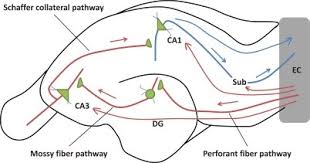
A general overview of the hippocampal pathway illustrates the various downstream and upstream connections present, allowing our memory to be so refined!!
A Ways Away
While H.M.’s case, in conjunction with various other studies over the years, have allowed us to develop an understanding of hippocampal mechanisms, society is far from satisfied in terms of knowing all we can. As aforementioned, the most prominent condition involving the hippocampus is Alzheimer’s Disease. While we have the ability to understand the molecular mechanisms behind it, the current approach to the treatment, focused on eliminating the cause rather than actual permanent protection, is fundamentally flawed. Additionally, relating directly to the case of H.M., we have developed further understanding of the hippocampus and how it relates to seizures, along with formulating treatments more applicable than removing the entirety of the hippocampus. Vagus nerve stimulators are thought of as a promising option for seizure treatment, and low carb diets, which modulate brain activity and establish a level of constancy, are likely the best natural fix when it comes to seizure modulation.
Wrapping It Up
Science is humbling and gratifying all at once. One man’s tragedy is society’s blessing. While H.M. unfortunately was affected by his accident for the rest of his life, he lived a long and full life and serves as an honorable reminder that contributions to society come in many ways. All must be respected.



 NeuralAYM
Leave a reply to Darryl B Cancel reply